Is Using AI for Homework Cheating? An Honest Guide for Students
Using AI for homework isn’t automatically cheating — it depends entirely on what you ask it to do and whether your teacher allows it. According to PEW Research Center, most teens already sense this line themselves. A good homework AI can explain a concept or quiz you on material you’re struggling with — that’s learning. The same tool can also write your entire essay for you — that’s cheating. Same tool, opposite outcomes.

This guide draws the line clearly, shows how school and university policies actually treat AI, explains why AI detectors get it wrong, and gives you a simple test to run before you submit anything. No lecturing — just what you actually need to know.
The Honest Answer: It Depends on How You Use It
Whether using AI for homework counts as cheating comes down to three things: what you asked the AI to do, whether your teacher allows it, and whether you’re presenting the AI’s work as your own. There’s no single universal rule, because every school, every instructor, and every assignment treats generative AI differently. That’s frustrating if you want a clean yes-or-no answer, but it’s also the honest one.
Learning with AI vs. bypassing learning
The core distinction is simple to state even if it’s not always simple to apply: using AI to understand something is learning, and using AI so you don’t have to understand it is the problem. Ask a homework AI helper to break down a confusing concept, walk through a practice problem, or explain why your answer was wrong, and you’re still doing the thinking — the AI is just a tutor. Ask it to produce a finished answer you copy in without engaging with it, and you’ve outsourced the learning itself.
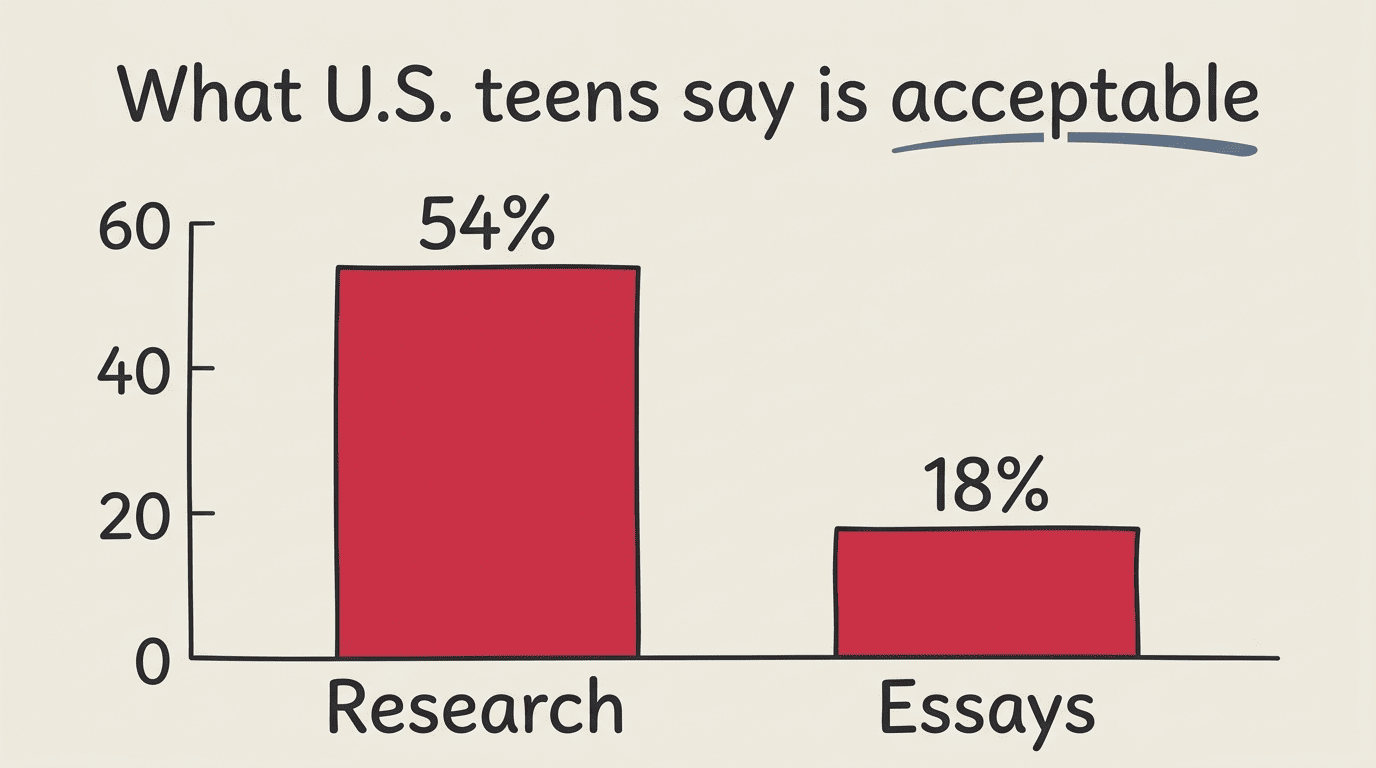
Students themselves seem to draw a similar line. PEW Research Center found that 54% of teens consider it acceptable to use AI for research, but only 18% think it’s acceptable for writing essays. That 36-point gap isn’t random — it tracks almost exactly with how much of the actual thinking gets handed off to the tool.
Why “it depends” is the real answer
“It depends” sounds like a dodge, but the data backs it up. Challenge Success, a research initiative out of Stanford that surveyed roughly 30,000 students, found that 32.7% admitted to copying someone else’s homework, while 32.8% admitted to using AI as unauthorized help on an assignment. Those numbers are nearly identical. AI didn’t invent a new form of cheating — it made an old shortcut easier to reach, which is exactly why the same rules that governed copying a classmate’s homework now apply to copying an AI’s output.
When Using AI Crosses Into Cheating
Most confusion about AI and cheating disappears once you separate “using a tool” from “handing off the work.” Academic integrity offices at universities across the US have spent the last two years writing this distinction into formal policy, and it holds up regardless of subject or grade level.
The bright line: whose thinking is it?
The clearest rule available is this: if the final work represents the AI’s thinking as yours, it’s cheating. Northern Michigan University’s Center for Teaching and Learning spells this out concretely — generating an entire essay, or having AI produce homework answers in math or computer science and submitting them without doing the underlying work, both count as academic dishonesty.
| Legitimate help | Crosses the line |
|---|---|
| Asking AI to explain a concept you’re stuck on | Asking AI to write your essay from scratch |
| Using AI to generate a practice quiz | Submitting AI-solved problems as your own graded work |
| Getting feedback on a draft you already wrote | Pasting AI output directly into a submission |
| Brainstorming topic ideas before you write | Having AI complete a test or timed assignment |
| Checking your understanding of a reading | Presenting AI-generated code as your own without disclosure |
Uncited AI is dishonesty even when AI is allowed
Here’s the part students most often miss: even at schools where AI use is permitted, using AI-generated writing without citing it is still treated as cheating — the same way using someone else’s ideas without credit is treated as plagiarism, regardless of whether you were “allowed” to get help. The International Center for Academic Integrity frames this through its Fundamental Values — honesty, trust, fairness, respect, responsibility, and courage — which underpin nearly every US honor code, whether or not AI is mentioned by name.
The AI Spectrum: Green, Yellow, and Red Zones
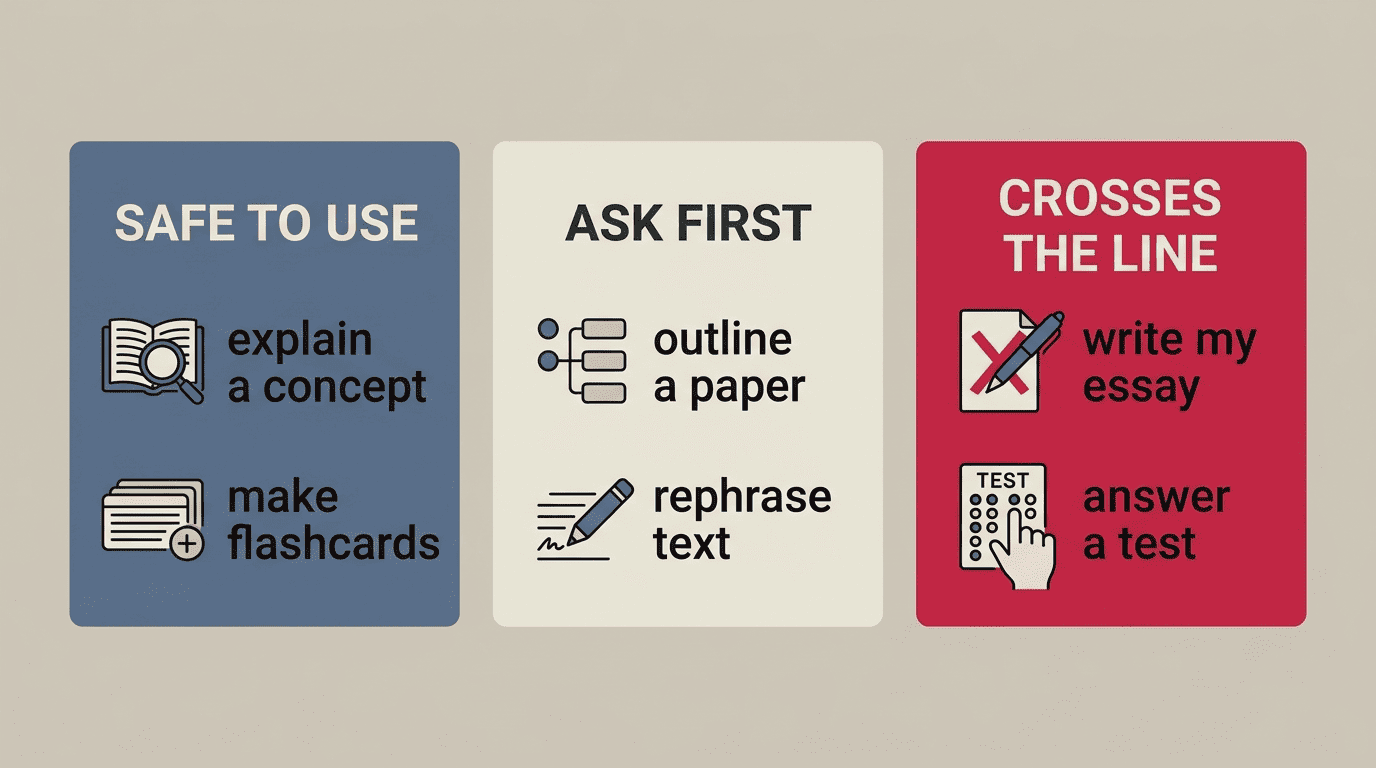
Not every use of AI sits in the same risk category. It helps to think in three zones rather than a single line.
Green zone — almost always fine
These uses are widely accepted, even at schools with strict AI policies:
- Explaining a concept you don’t understand
- Generating practice quizzes or flashcards to study from
- Checking your understanding after you’ve written an answer
- Brainstorming ideas before you start writing
- Getting feedback on a draft that’s already yours
Student consensus backs this up: in a survey by the Menlo-Atherton Chronicle, 8 out of 9 students agreed that using AI to clarify an assignment’s instructions isn’t cheating.
Yellow zone — ask first
These uses depend heavily on the assignment and the teacher, so confirm before you rely on them:
- Outlining a paper before you write it
- Rephrasing sentences you already wrote
- Generating examples to illustrate a point
- Translating text as a study aid
Red zone — cheating almost everywhere
These uses are treated as cheating at nearly every US school, regardless of stated AI policy:
- Having AI write your essay
- Submitting AI-solved graded problems as-is
- Letting AI answer a test or quiz
- Pasting AI output unchanged into a submission
In the same Menlo-Atherton Chronicle survey, 8 of 9 students agreed that having AI complete an entire graded test counts as cheating — the closest thing to universal agreement the survey found.
How Schools and Universities Treat AI
There’s no national standard for AI in schoolwork. Instead, policy gets set at the level where it actually matters: the individual class.
The syllabus is the law
Policy is set per-instructor and per-assignment, and the syllabus — backed by the school’s honor code — is the actual authority you’re bound by. The University of Mary Washington’s Honor System puts it directly:
AI tools should be used only with the explicit and clear permission of each individual instructor, and then only in the ways allowed by the instructor.
University of Mary Washington, Honor System
In practice, that means one professor can ban AI outright while another in the same department requires you to disclose exactly how you used it, and a third might actively encourage it for brainstorming. Assume nothing carries over between classes.
Honor codes and integrity offices
An honor code is a school’s formal statement of the values students agree to uphold — honesty, trust, and responsibility chief among them — and academic integrity offices are the bodies that handle violations when they’re reported. Most US universities updated their AI-specific policies during the 2024–2025 academic year, and NMU’s guidance advises approaching suspected AI-related cheating with fairness and transparency: AI classifiers “can flag suspicious cases, but final decisions should involve human review to account for context and avoid false positives” rather than an automated verdict.
Policies generally fall into one of four categories:
- Full ban — no AI use permitted on any part of the assignment
- Disclosure required — AI use is allowed but must be cited or explained
- Allowed for specific tasks — permitted for brainstorming or research, not for final writing
- Actively encouraged — instructor builds AI use into the assignment itself
Can Teachers Tell? AI Detectors and Why They’re Unreliable
A lot of student anxiety around this topic comes from assuming detection is more accurate than it actually is.
How AI detectors work (and fail)
AI detection tools estimate the probability that a piece of text was AI-generated by analyzing patterns like perplexity and burstiness — essentially, how predictable and how varied the sentence structure is. The problem is that this is a statistical guess, not a fingerprint. Detectors produce both false positives, flagging human-written text as AI-generated, and false negatives, missing text that actually was AI-written. Even companies that sell detection tools acknowledge the limitation publicly. NMU’s guidance explicitly states that flagged submissions need human review specifically to avoid penalizing students over false positives.
| Detector claim | Reality |
|---|---|
| “Detects AI-generated text with high accuracy” | Accuracy varies widely and drops on edited or paraphrased text |
| “A high score proves AI use” | A high score is a statistical signal, not proof |
| “Works equally well for all writers” | Disproportionately flags non-native English speakers and neurodivergent students |
| “Can be used as the sole basis for a violation” | Most institutions require human review before any action is taken |
Why detection isn’t proof
False positives disproportionately affect non-native English speakers and neurodivergent students, whose natural writing patterns can resemble the statistical signatures detectors look for. A flag is a signal, not a verdict — and that’s exactly why honest use plus disclosure protects you far better than trying to write in a way that “beats” a detector. If you’re ever flagged incorrectly, being able to show your drafting process, search history, or notes matters more than arguing with a detection score.
How to Use AI Ethically (Without Crossing the Line)
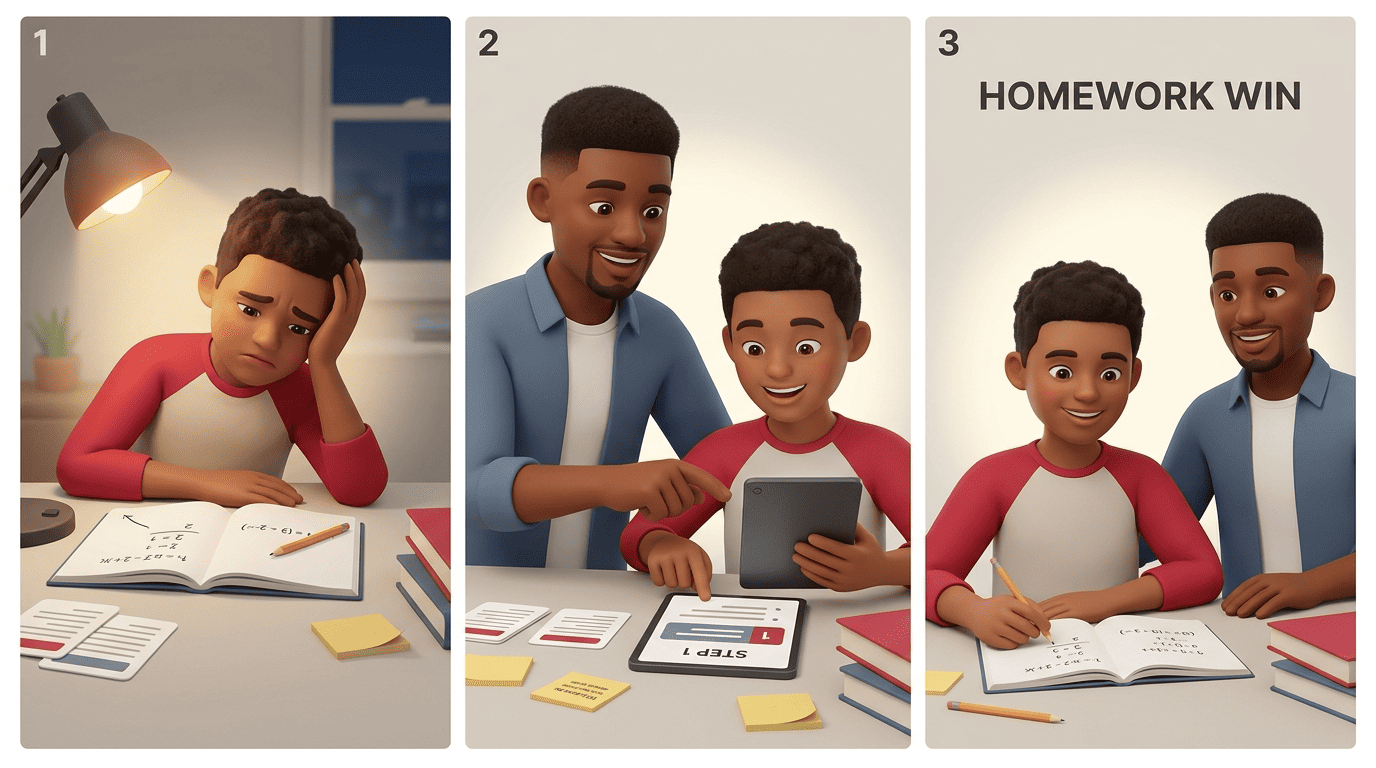
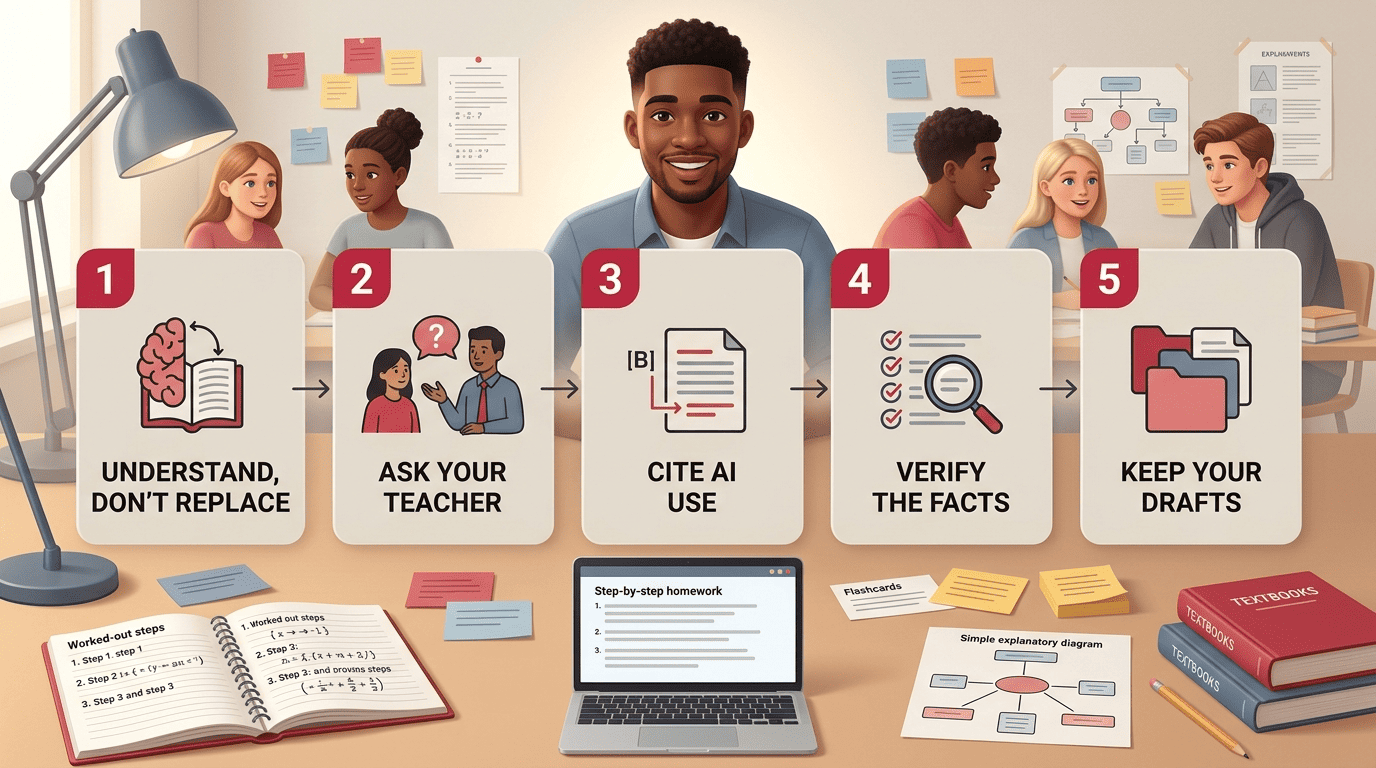
Here’s a step-by-step way to stay on the right side of the line on any assignment.
- Use AI to understand, not to replace your thinking. Ask it to explain, not to answer.
- Ask your teacher first and follow the syllabus. Assume nothing is allowed until it’s confirmed.
- Cite or disclose AI use when required. Treat it like any other source.
- Verify everything AI tells you. UMW warns that AI “can fabricate research, generate a fake source” — always double-check facts and citations before you rely on them.
- Keep your drafts and notes. They’re your best evidence of an honest process if anyone ever asks.
- Reflect before you submit. Would you be comfortable explaining exactly how you used it?
Framed positively, this isn’t just risk management — it’s a skill. The World Economic Forum’s 2025 Future of Jobs report lists AI and big data skills among the fastest-growing skill categories globally, which means learning to use AI tools responsibly now has value well beyond any single assignment.
Protect your own learning
Roughly 58% of surveyed faculty say their top concern about student AI use isn’t cheating in the disciplinary sense — it’s erosion of critical thinking. A 2025 study found that frequent AI use correlated with weaker critical thinking performance among students who leaned on it heavily. The fix isn’t avoiding AI study tools altogether; it’s using them as a tutor that explains rather than a machine that answers, so the understanding stays yours even after the chat window closes.
What Happens If You Get Caught
Consequences scale with how the violation is classified, and they’re rarely limited to a single assignment.
Typical consequences
Penalties range from an informal warning to a zero on the assignment, a failing grade in the course, a formal note on your academic record, or expulsion through an honor council review. Penn Foster, for example, applies an automatic policy: work found to be more than 20% copied or AI-generated triggers a 1% grade penalty and a formal warning, and its Academic Review Board has the authority to terminate a student’s enrollment for repeated or serious violations.
| Severity | Typical consequence |
|---|---|
| First minor violation | Warning, resubmission, or partial grade penalty |
| Confirmed uncited AI use | Zero on the assignment |
| Repeated or serious violation | Failing grade in the course |
| Severe or repeated after warning | Formal record + honor council review |
| Egregious case (e.g., AI-completed exam) | Suspension or expulsion |
Honesty is the cheaper path
Self-reporting is unreliable in the other direction too — researcher Rismanchian found that over half of students observed using AI during a study later denied it when asked directly. But getting caught in a denial almost always compounds the original penalty, since it adds a trust violation on top of the integrity one. Owning your process and asking about AI use up front is the lower-risk move, and it tends to build trust with instructors rather than erode it.
The Simple Test: Is This Cheating?
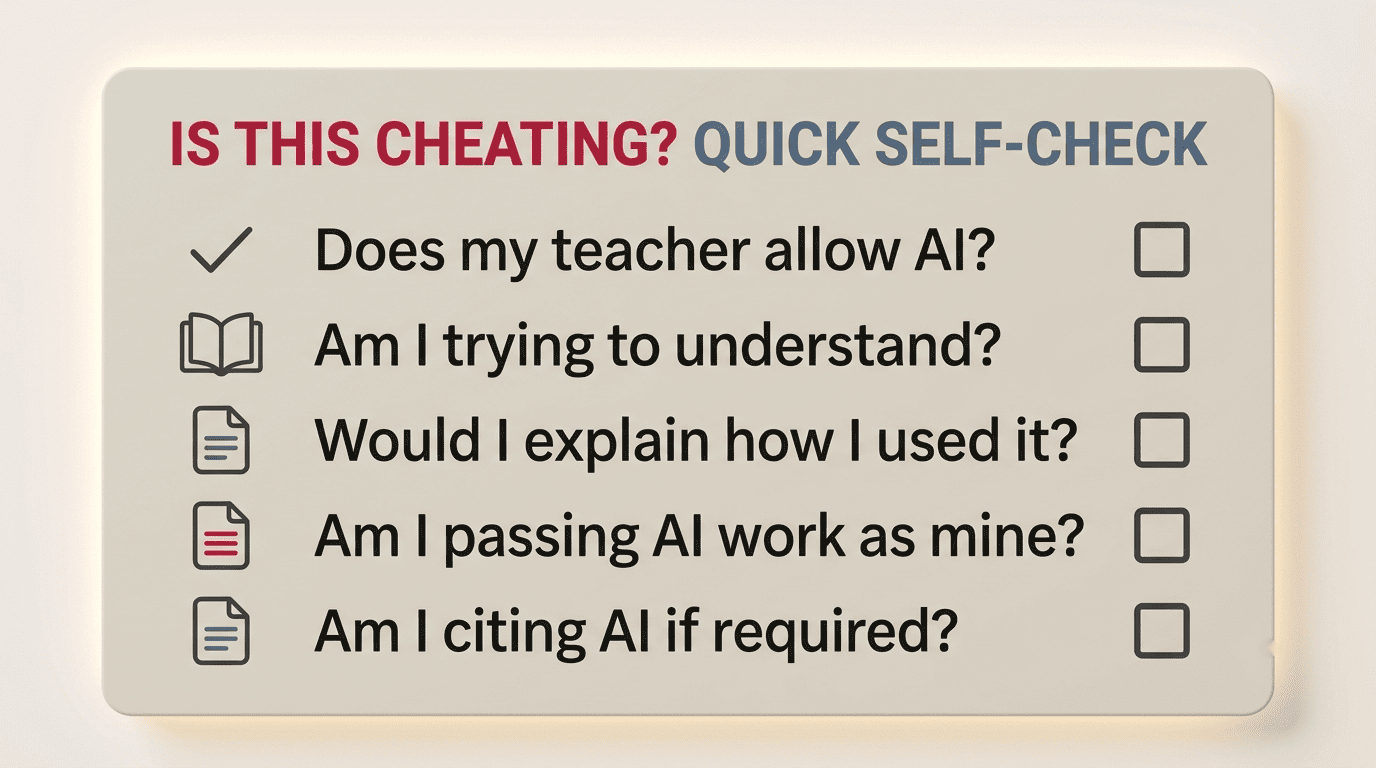
Run through this quick self-check before you use AI on any assignment:
- Does my teacher or syllabus allow AI on this task?
- Am I using it to understand the material, or to avoid understanding it?
- Would I be comfortable telling my teacher exactly how I used it?
- Am I presenting AI’s work as if it were entirely mine?
- Am I citing or disclosing AI use if my school requires it?
If any answer points toward hiding what you did or letting AI do the actual thinking, stop — that’s the signal you’ve crossed from AI for schoolwork into AI as a substitute for it.