
Free AI Homework Helper: What “Free” Really Gets You (and How to Use It to Actually Learn)
Stuck on a tricky problem at 10 p.m. with no one to ask? A free homework AI can walk you through it in seconds — for real, without a credit card.

Honest free options do exist, but “free” means something different at every tool, and it works best when you use it to understand the material, not to skip it. This guide breaks down what free actually includes, a step-by-step way to use a free homework AI helper to learn faster, and how to stay on the right side of academic honesty.
What a Free AI Homework Helper Actually Does
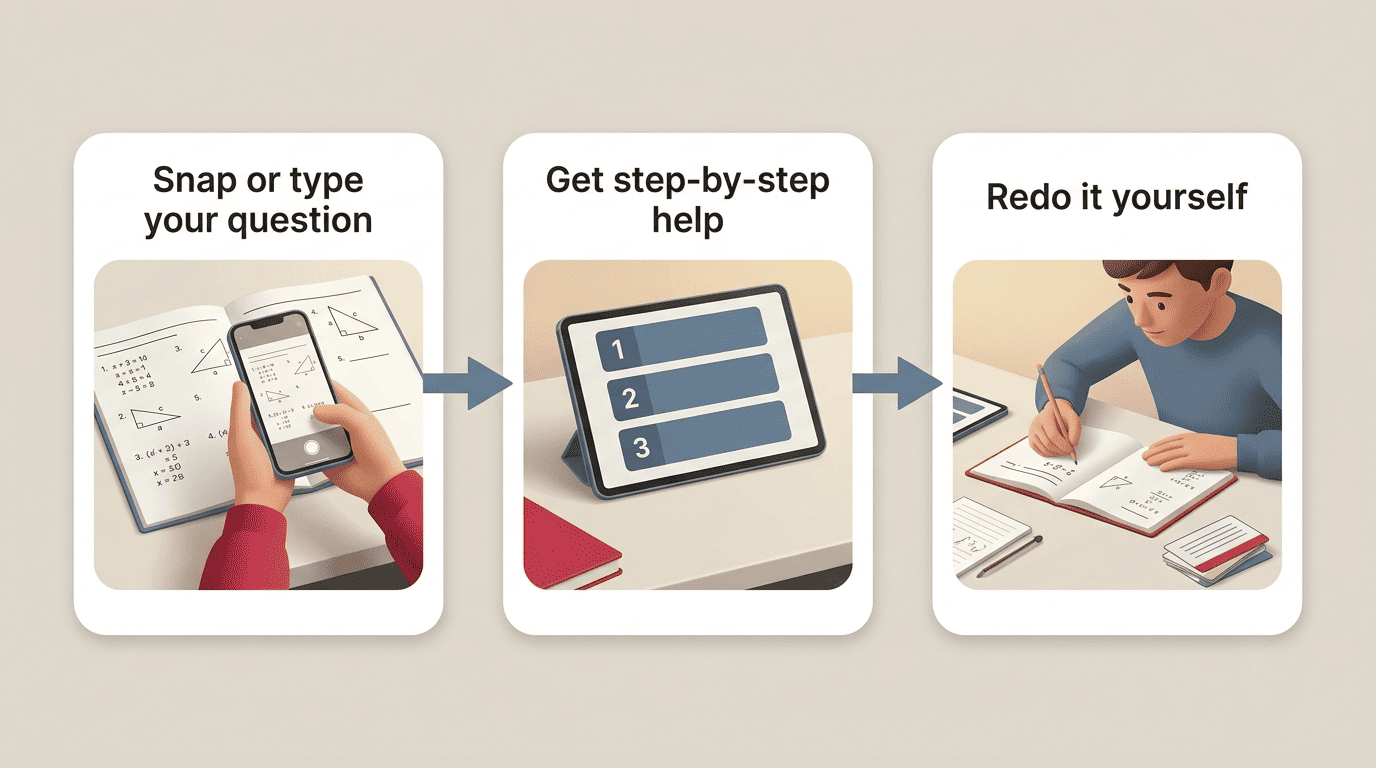
A good AI homework helper takes whatever you throw at it — a typed question, a photo of a worksheet, or a scanned PDF — and turns it into a worked answer in seconds. Most tools run 24/7 with no sign-up required, so a question at midnight gets the same response as one at noon. The part that matters most isn’t the final number; it’s the explanation that shows how you got there.
- Accepts typed questions, photos, and PDF uploads
- Answers in roughly ten seconds for straightforward problems
- Available around the clock, no account needed on many tools
- Breaks the solution into steps instead of just a final answer
- Lets you ask follow-up questions on the same problem
- Keeps a history of past questions you can revisit before a test
From a photo or a typed question to a worked-out answer
Most free AI homework solvers work the same basic way: type the question, snap a photo of it, or upload a PDF, and the tool returns a solution within seconds. The best ones don’t stop at the answer — they show the reasoning behind each step, which is the part you actually need to remember for the next quiz.
- Type a question directly into the chat box
- Snap a photo of a textbook problem or worksheet
- Upload a PDF or scanned page of homework
- Get a step-by-step breakdown, not just a final answer
- Ask a follow-up if one step doesn’t make sense
- Review the explanation again later while studying
More than answers: explanations, examples, practice
Beyond a single answer, many tools offer different modes — a full explanation, a quick answer-only mode, a condensed study guide, or a freshly generated practice problem similar to the one you just solved. That combination of explanation plus practice is what separates a tool you learn from from one you just copy from.
Is It Really Free? What “Free” Includes (and the Hidden Limits)
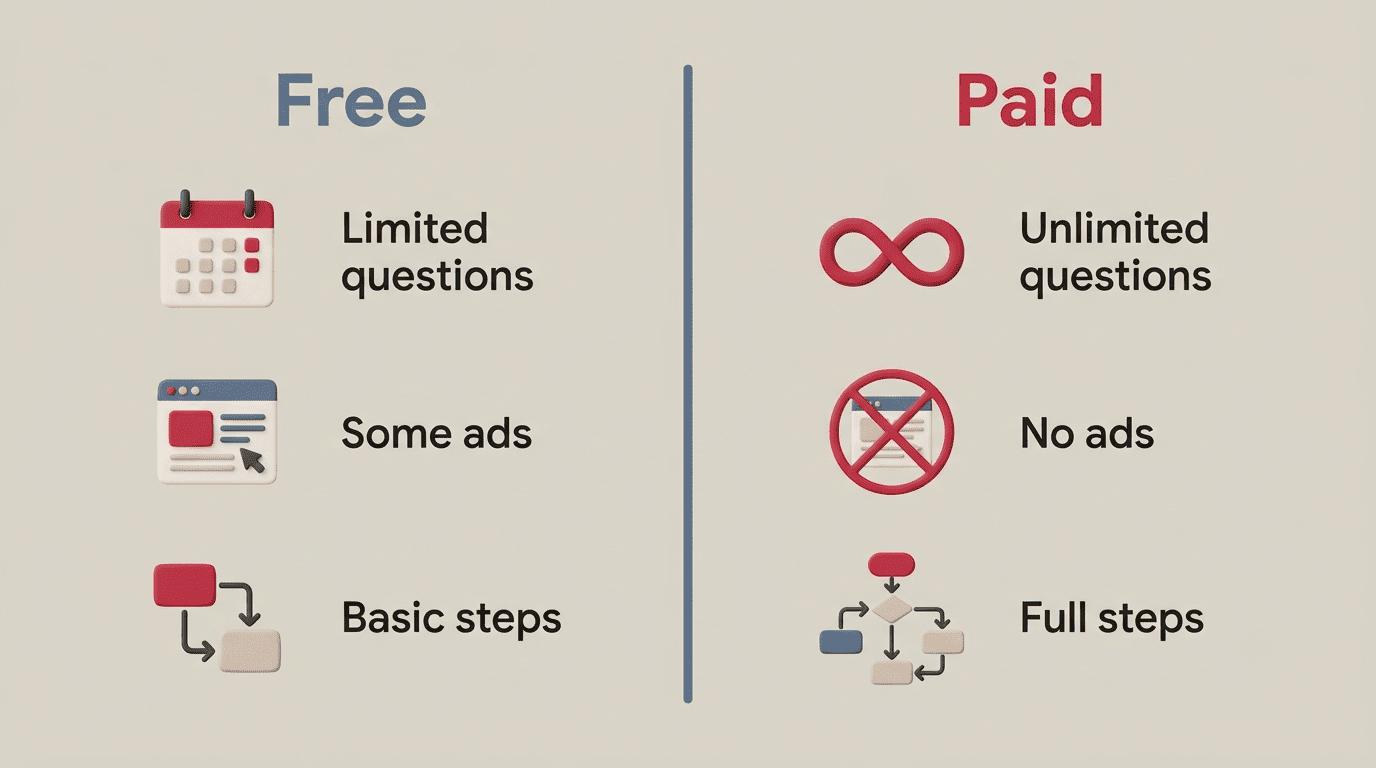
“Free” is real, but it rarely means unlimited. Some tools cap you at a set number of tries per day, some stay free forever but show ads, and some unlock extra step-by-step modes or remove ads only on a paid tier. None of that makes the free version useless — it just means it’s worth knowing the limit before you hit it the night before a deadline.
The honest version of “free”
Free, no-signup homework AI helpers really do exist — you won’t always need an account or a card. But the fine print varies: a daily cap on how many questions you can ask, ads mixed into an otherwise free experience, or a smaller free tier next to a paid plan with unlimited use and no ads. Treat any specific numbers you see as a rough guide, since free plans and their limits change often — check the tool’s current terms before you rely on it for a deadline.
Free vs paid — at a glance
| Feature | Typical Free | Typical Paid |
|---|---|---|
| Daily questions | Limited (a set number per day) | Unlimited |
| Ads | Often shown | Usually none |
| Advanced modes / step detail | Some modes available | Full access to all modes |
| File size / question length | Smaller caps | Larger caps |
| Response speed | Standard | Often faster/priority |
For most everyday homework — a math problem, a quick science question, a paragraph to check — the free tier is genuinely enough. The paid tiers mostly matter if you’re working through dozens of problems in one sitting.
Every Subject, Not Just Math
A homework AI helper isn’t limited to math, even though that’s often the first thing people picture. Coverage typically spans math, science, writing, reading, history, and even foreign languages, spread across grade levels from elementary school through college.
Which subjects a homework AI covers
- Math — from basic algebra through calculus
- Science — physics, chemistry, biology
- English & essay writing — grammar, structure, feedback
- Reading & literature — summaries and comprehension
- History & social studies — timelines, causes, and effects
- Foreign languages — vocabulary and grammar checks
- Test prep — SAT/ACT-style practice questions
How it helps you learn in each subject
| Subject | Ask it for | How that helps you learn |
|---|---|---|
| Math | “Explain each step” | You see the method and can repeat it yourself next time |
| Writing | “Outline and feedback, not the essay” | You get structure and notes, but you still write it |
| Science | “Why does this formula work?” | You build understanding instead of memorizing a rule |
| Reading | “Summarize this, then quiz me” | You check comprehension instead of skimming |
| History | “Show the timeline and cause-effect” | You see how events connect, not just isolated dates |
| Test prep | “Make me five practice questions” | You rehearse the skill instead of just reading about it |
Think of a homework AI helper less like an answer machine and more like a free tutor sitting next to you — one that’s better used for “explain this” than “just tell me.”
How to Use a Free AI Homework Helper to Actually Learn (Step by Step)
Using an AI study helper well comes down to how you ask, not just what tool you pick. The workflow below turns a quick-answer habit into an actual study routine — and it takes the same amount of time either way.
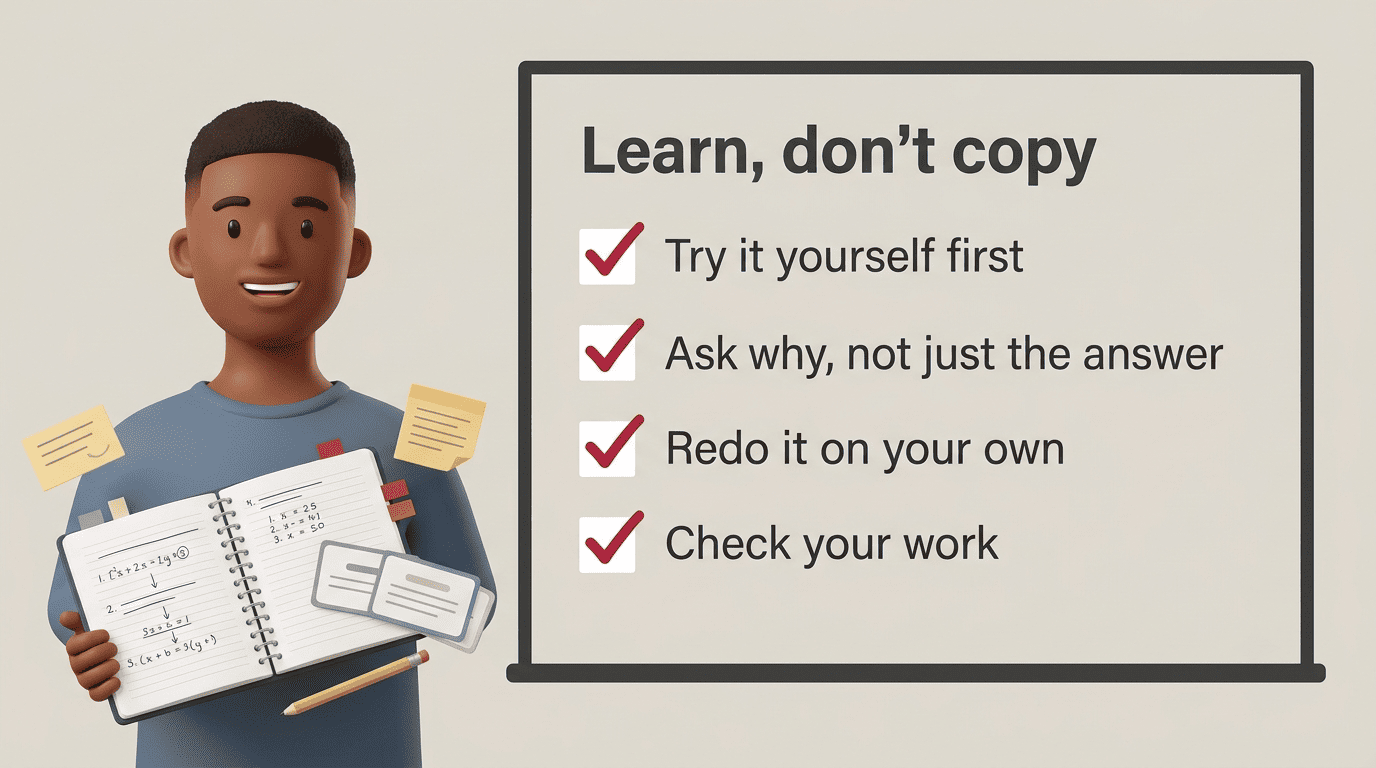
The “learn, don’t copy” workflow
- Try the problem yourself first, even if you get stuck partway through.
- Ask the AI to explain the specific step you’re stuck on — not the final answer.
- Read the reasoning carefully, then close the chat and redo the problem on your own.
- Ask for a similar practice problem and solve it without help.
- Use the tool to check your finished work and pinpoint exactly where you went wrong.
- Summarize what you learned in one or two sentences, in your own words.
That loop — attempt, ask, redo, check — is what makes a free homework AI genuinely useful past tonight’s assignment.
Prompts that teach instead of tell
- “Explain why this works, don’t just give me the answer.”
- “Give me a hint, not the full solution.”
- “Quiz me on this chapter before I move on.”
- “Check my essay’s structure, but don’t rewrite it for me.”
- “Show me one worked example, then let me try the next one myself.”
How you phrase the question decides whether you get a patient tutor or a shortcut — the tool responds to whichever one you ask for.
Accuracy: AI Can Get Homework Wrong
Even solid tools make mistakes. Some AI homework solvers publish accuracy figures around the high-90s percent, with no claim of being perfect, and others flag directly in their own interface that answers can be wrong. That’s not a reason to avoid them — it’s a reason to double-check the logic, especially in math and on anything involving specific facts or dates.
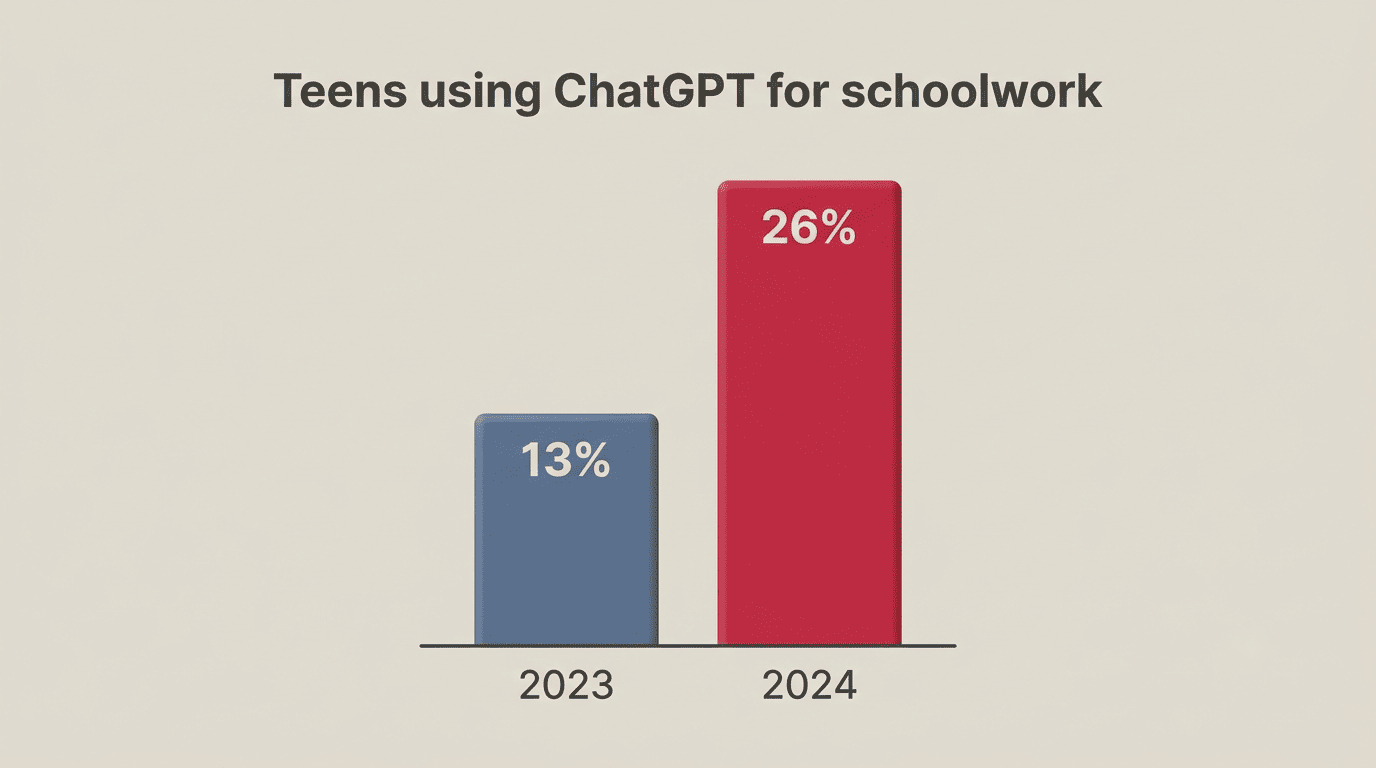
The share of teens who say they use ChatGPT for their schoolwork has risen to 26%, according to a Pew Research Center survey of U.S. teens ages 13 to 17. That’s up from 13% in 2023.
Pew Research Center
That’s a fast-growing habit, which makes the checking step more important, not less. Verifying an answer — redoing the math, cross-referencing a date, reading a cited source — is also, conveniently, how you actually learn the material instead of just borrowing it.
Is Using AI for Homework Cheating?
Here’s the honest line: using AI to understand a concept and check your own work is studying. Turning in AI-generated work as if you wrote it yourself is not. Most schools now have some kind of policy tied to broader academic integrity standards, and it’s worth a quick check with your teacher or your school’s handbook, since the rules genuinely differ from one classroom to the next.
Deliberate or reckless representation of another’s words, thoughts, or ideas as one’s own without attribution in connection with submission of academic work, whether graded or otherwise.
The Writing Center, University of North Carolina at Chapel Hill
That definition, from the University of North Carolina at Chapel Hill’s Writing Center, is a useful gut check: did you represent someone — or something — else’s work as your own? Using a free homework AI helper to get a hint, an explanation, or a practice quiz doesn’t cross that line. Copy-pasting its output onto your submission does. When in doubt, ask your teacher directly; most would rather answer that question up front than deal with it after the fact.