
AI Science Homework Helper: How to Actually Learn Biology, Chemistry, and Physics (Not Just Copy Answers)
Stuck on a titration problem at 11 p.m. or lost in a cell-cycle diagram? A good homework AI can walk you through the reasoning step by step — so the concept finally clicks, instead of just handing you a number to copy. That distinction, explaining versus answering, is what separates a tool that helps you learn from one that just does the work for you, a line education researchers at institutions like the National Science Teaching Association care about a lot.

This guide shows what an AI science homework helper does well across biology, chemistry, physics, and earth science, how to use it to actually learn, and — just as important — where AI gets science wrong so you always double-check.
What an AI Science Homework Helper Actually Does
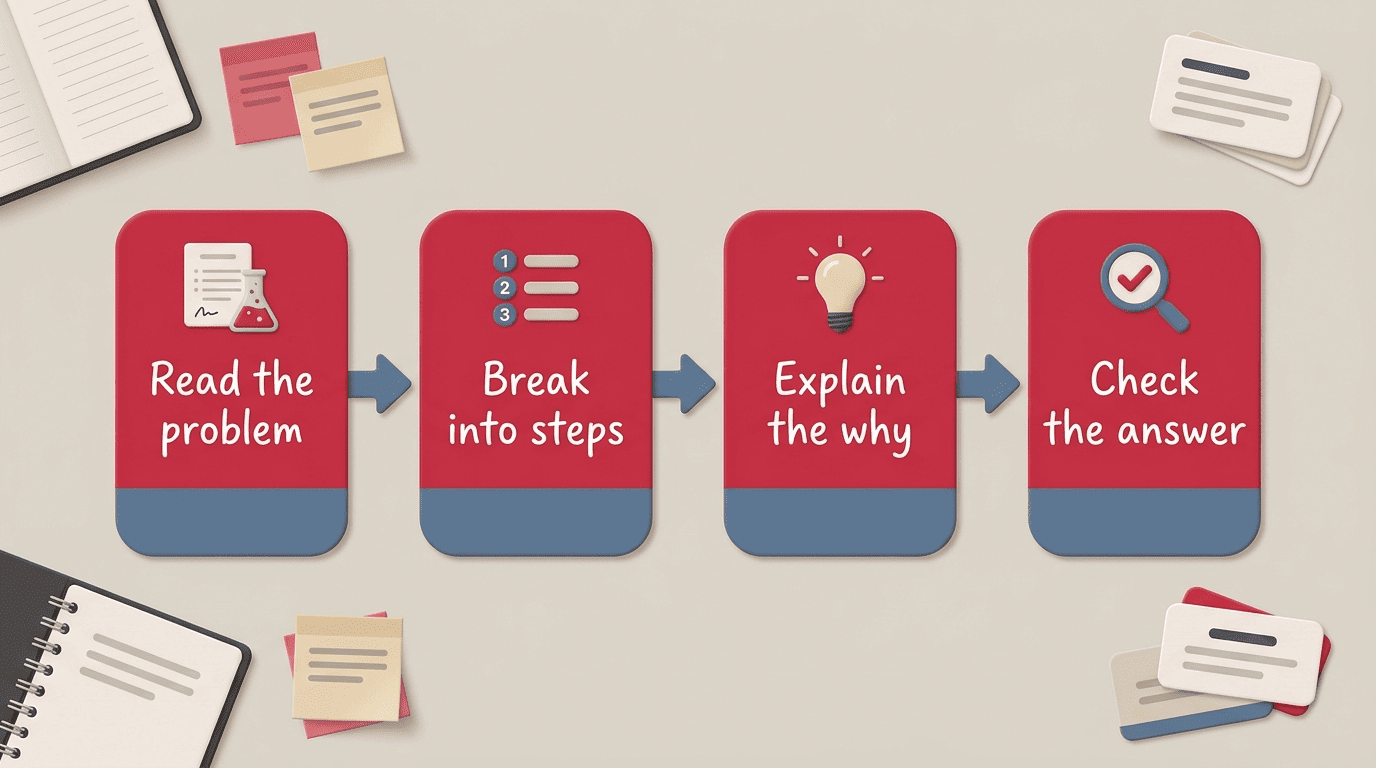
A science AI solver takes almost any format you throw at it. Snap a photo of a textbook problem, upload a PDF worksheet, paste a screenshot with Ctrl+V, or just type the question — the AI reads it, breaks it into steps, and explains the “why” behind each one, usually within seconds. Most tools scale from first-grade science all the way to university and even PhD-level material, and they’re available 24/7, which matters more than it sounds when a lab report is due at 8 a.m.
From a photo, a typed question, or a PDF
The typical flow looks the same across most AI science help tools: you capture the problem, the AI parses it, and it returns a worked solution with reasoning attached rather than a bare answer. That third step — the explanation — is what turns a homework AI helper from an answer machine into an actual study tool.
Explaining vs. answering — the difference that matters
A genuinely useful AI science tutor doesn’t just spit out a final number. It shows which law, formula, or concept applies and walks through why it applies there. If a tool only gives you “the answer is 4.2 mol,” you’ve learned nothing except how to retype a number onto your worksheet. If it shows you why you multiply moles by molar mass, that reasoning is reusable on the next problem — and on the test.
The table below shows roughly where an AI science problem solver is strong, and where you need to slow down and check its work yourself.
| What it’s great at | Where to be careful |
|---|---|
| Explaining a concept in plain language | Exact numerical final answers |
| Breaking a problem into clear steps | Units and significant figures |
| Generating examples and analogies | Reaction mechanisms in organic chemistry |
| Checking your own reasoning | Very recent or highly specific data |
| Making flashcards for review | Citing precise original sources |
Science, Subject by Subject
An AI science homework helper is really a set of subject specialists layered on one interface. Coverage generally spans four broad areas, each with narrower subfields nested inside:
- Biology — cellular processes, genetics, ecology, anatomy, microbiology
- Chemistry — organic, inorganic, physical, analytical, biochemistry
- Physics — mechanics, electromagnetism, waves, and (on some tools) basic nuclear and relativity topics
- Earth & space science — plate tectonics, weather and climate, astronomy
Biology — concepts, diagrams, and processes
A science homework helper can walk through cellular respiration and photosynthesis stage by stage, explain the phases of mitosis and meiosis, work through genetics problems like Punnett squares, and help you read an unfamiliar diagram. Subfields commonly covered include ecology, anatomy, genetics, and microbiology. When you want to sanity-check a biology or genetics fact against a real reference, the National Human Genome Research Institute and MedlinePlus are solid, freely available starting points.
Chemistry — balancing, stoichiometry, and reactions
Balancing equations, mole-to-mole stoichiometry, classifying reaction types, and organic chemistry mechanisms are all common requests for an AI chemistry homework helper. Organic mechanisms are worth flagging early: they’re one of the areas where an AI science problem solver is most likely to sound confident while getting a step wrong, so treat those explanations as a starting point, not a final answer.
Physics — from free-body diagrams to circuits
An AI physics problem solver typically handles kinematics, forces and free-body diagrams, energy and work, circuits, and waves. It’s genuinely useful for helping you set up the right approach to a problem — which formula, which frame of reference — but you still need to check the arithmetic and the units yourself once the setup is right.
Earth & space science
Plate tectonics, the water and carbon cycles, weather and climate patterns, and basic astronomy round out most earth science coverage. For a reliable, up-to-date first source on planetary and space science topics, NASA Science is hard to beat and costs nothing to check.
How to Learn With AI — Not Just Copy It
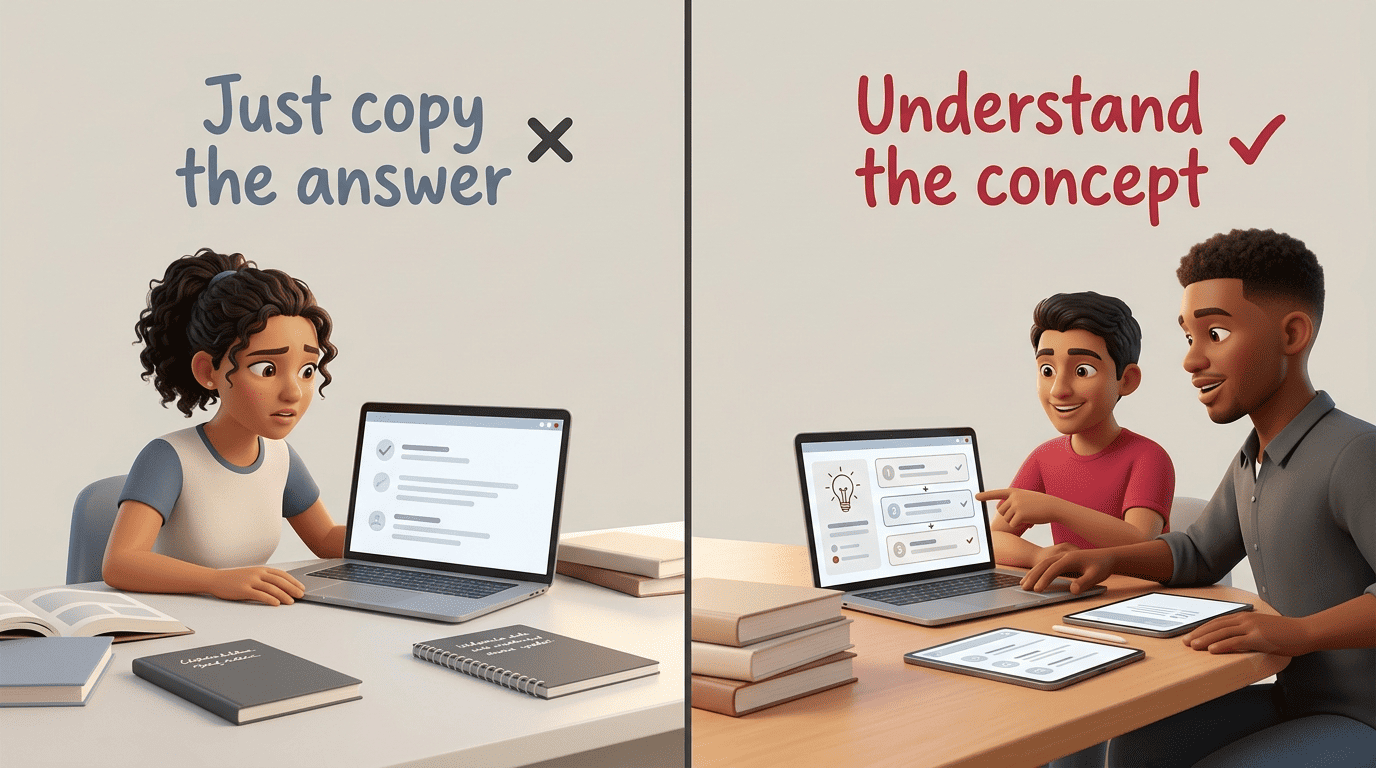
Plenty of homework tools market themselves around “plagiarism-free” or “guaranteed unique” answers. That framing is a trap: a unique wrong understanding is still a wrong understanding. The goal isn’t producing text nobody else has — it’s actually knowing the material when the test has no AI in the room.
A workflow that builds real understanding
- Try the problem yourself first, even if you get stuck halfway through.
- Ask the AI to “explain why,” not just “give me the answer.”
- Solve a similar problem on your own afterward to confirm it actually stuck.
- Ask the AI to quiz you on the concept instead of just reviewing your work.
- Cross-check the final explanation against your textbook or teacher’s notes.
Following even three of these steps turns an AI science homework helper into something closer to a tutor than a shortcut.
The integrity line — and a real quote
Using AI to understand a concept is studying. Submitting AI-generated work as your own, unedited and unreviewed, crosses into academic dishonesty at most schools. The line isn’t about the tool — it’s about whether you can explain the answer yourself afterward.
“Student use of AI should support learning, not replace it. There should be open, transparent communication about the use of AI between the student and teacher. Work generated by AI is not considered the student’s own work.”
Middle Level Biology Teacher, quoted in “AI in the Science Classroom,” National Science Teaching Association
That transparency is the practical test: if you’d be comfortable telling your teacher exactly how you used the AI on a given assignment, you’re almost certainly on the right side of the line.
Where AI Gets Science Wrong (Always Verify)
This is the part most homework tools don’t advertise: large language models — the technology behind most AI science help tools — are pattern generators, not calculators or fact databases. They can be extremely convincing while still being wrong.
Common science mistakes AI makes
- Drops or mismatches units, and doesn’t consistently track significant figures.
- Confidently invents a reaction mechanism or biological detail that sounds right but isn’t (a known LLM failure mode sometimes called hallucination).
- Makes small arithmetic slips buried inside longer, multi-step problems.
- Pulls outdated or rounded-off constants instead of the current accepted values.
- Misreads a graph or data table in a way that sounds plausible but isn’t accurate.
Marketing claims of “95% accuracy” or “98% accuracy” that you’ll see on some AI science solver sites are self-reported by the vendor, not verified by an independent test — treat them as advertising, not evidence.
How to fact-check an AI science answer
| Red flag | How to check |
|---|---|
| A number with no units attached | Redo the dimensional analysis by hand |
| An unfamiliar biology or chemistry fact | Cross-check against NASA, MedlinePlus, or your textbook |
| A reaction mechanism explanation | Verify against your organic chemistry textbook |
| A precise physical constant | Confirm against a reference table, e.g. NIST |
| A graph interpretation | Re-read the axes and units yourself before trusting the summary |
How to Choose an AI Science Homework Helper
Not every science homework helper is built the same way, and the differences matter more once you’re relying on one regularly.
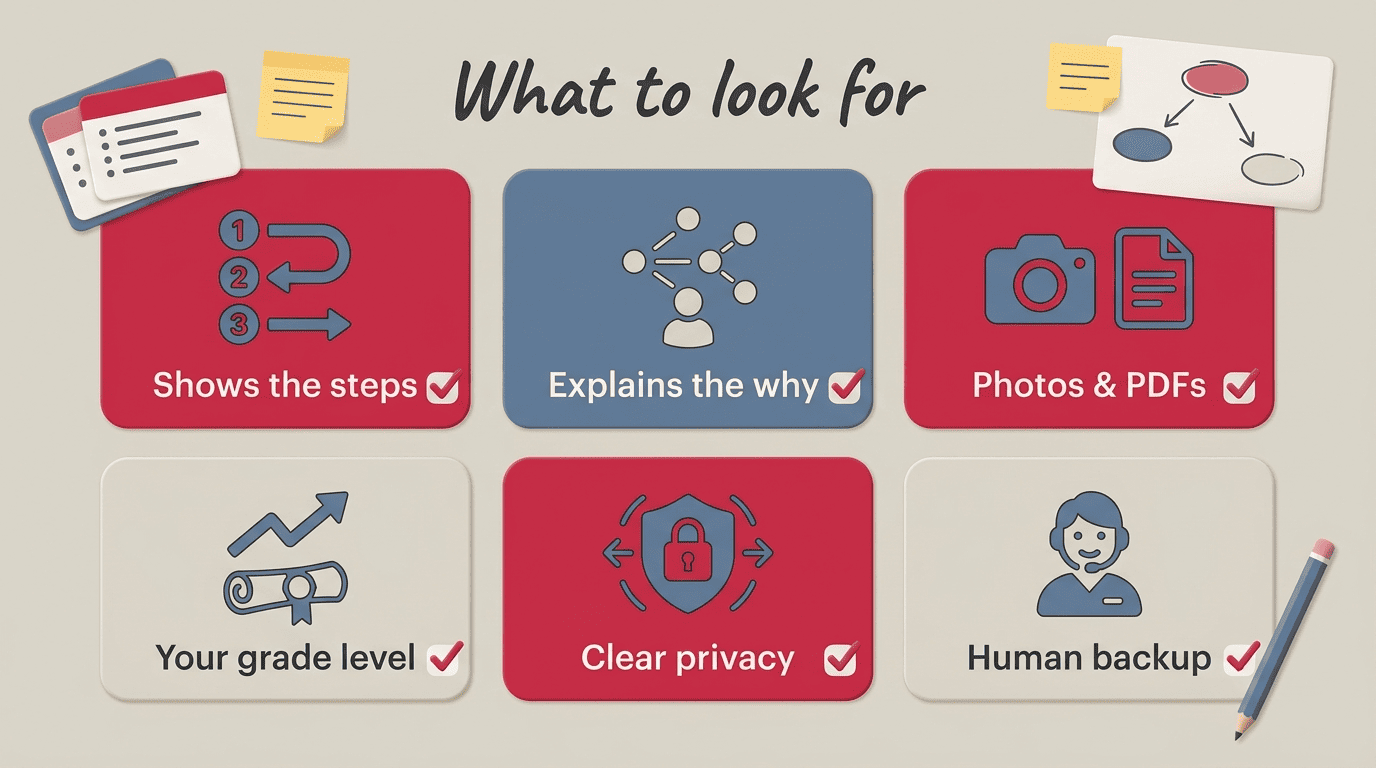
Shows its reasoning, not just the final answer. If a tool hides the steps behind a paywall or only shows the number, it’s not going to help you learn — it’s going to help you turn in work you can’t explain.
Explains the “why” behind each step. Look for a tool that names the law, formula, or concept it’s applying, not just the calculation.
Handles photos, PDFs, and typed text. Homework shows up in every format — a scanned worksheet, a lab handout, a typed prompt — and a helper limited to one input type will constantly slow you down.
Covers your actual level. Middle school biology and university organic chemistry need very different depth; check that the tool scales to where you are.
Has a clear privacy policy. You’re often uploading photos of your own schoolwork — know where that data goes before you rely on the tool daily.

Can escalate to a human expert. For genuinely disputed or unusual questions, some services route your problem to a live tutor or subject expert when the AI’s confidence is low.
Free vs. paid, and when a human helps
Most AI science homework helpers offer a free tier to get started, with paid plans removing daily limits or unlocking higher-level subjects. A rough pattern across the category:
- Free tier — limited daily questions, core subjects, typed or photo input
- Paid tier — higher or unlimited daily usage, advanced/college-level subjects, faster response
- Human escalation (free or paid, tool-dependent) — a live tutor or subject expert weighs in on disputed or unusual answers
For anything genuinely confusing, contested, or graded, a quick check with a live tutor or your teacher is still the most reliable backstop — AI is a first pass, not a replacement for a human who knows your class and your rubric.