
How to Use an AI Homework Helper for Essays (Without It Writing the Essay for You)
A homework AI is at its best when it acts like a patient writing tutor at 11 p.m. — brainstorming angles, poking holes in your thesis, and reacting to your draft — not when it hands you a finished essay to copy. The University of Kansas Center for Teaching Excellence puts the boundary bluntly: an AI homework helper for essays can offer ideas and feedback, but the writing itself still has to be yours. This guide shows the right way to use the tool so you turn in stronger work and actually get better at writing along the way.

The line is simple. The tool coaches your thinking; you do the writing. Cross that line and you risk your grade, your integrity, and — increasingly — a flag from your school’s honor code.
What an AI Homework Helper Should (and Shouldn’t) Do for Essays
The coach vs. the ghost-writer
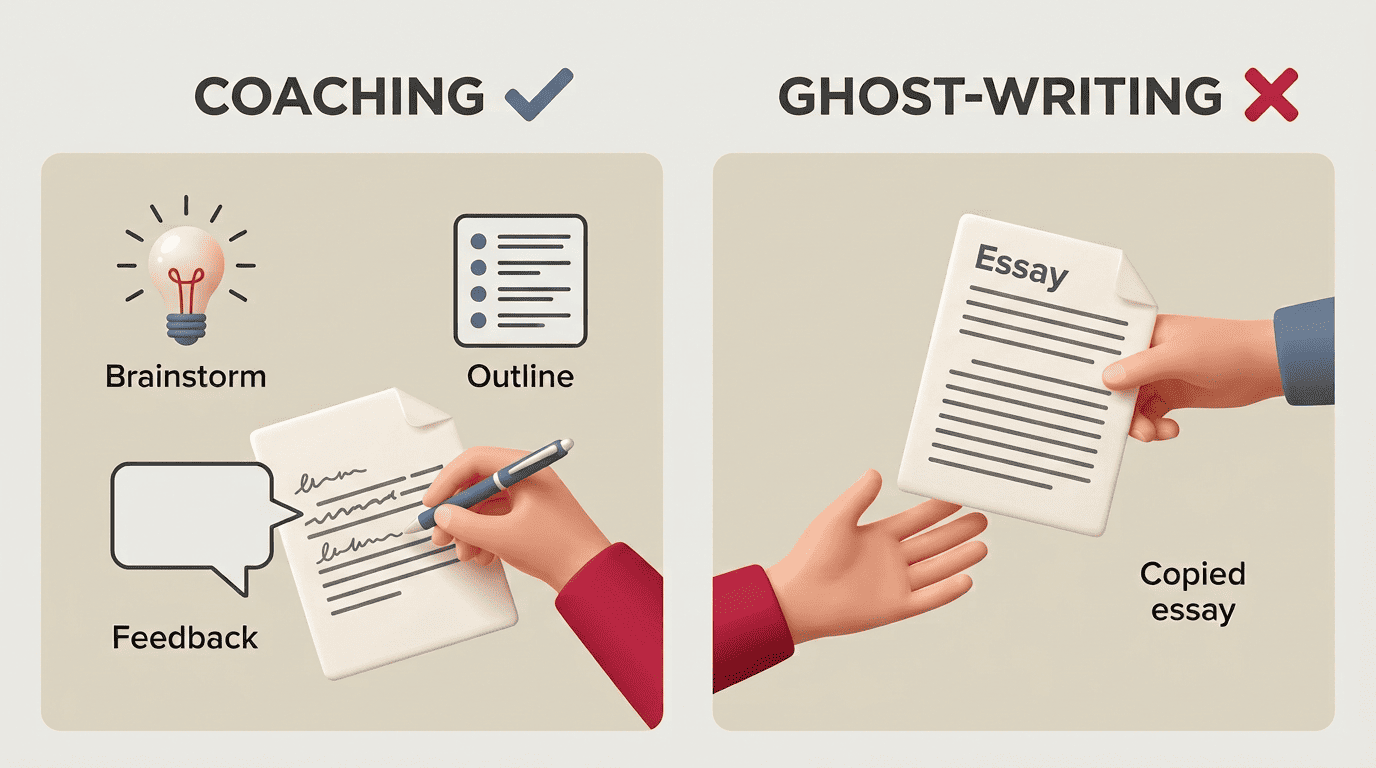
Every use of an AI essay helper falls into one of two buckets. Coaching means brainstorming, outlining, asking for feedback, and revising — the AI reacts to your ideas and your draft, but every sentence you submit is one you wrote. Ghost-writing means prompting “write my 5-paragraph essay on _” and turning in whatever comes back. Only one of those buckets is defensible if a teacher asks how you used the tool.
Turning in unedited AI-generated work as one’s own creation is academic misconduct.
University of Kansas Center for Teaching Excellence
That accountability doesn’t disappear just because a machine typed the words. Whatever you submit under your name is yours — errors, fabricated facts, and all. The KU center is explicit that students can’t blame the AI for mistakes; you’re still responsible for everything you turn in.
| Coaching use (green) | Ghost-writing use (red) |
|---|---|
| Brainstorming topic angles | Generating full paragraphs to submit |
| Pressure-testing your thesis | Writing your thesis statement for you |
| Feedback on a draft you wrote | Rewriting your draft’s sentences |
| Grammar and clarity checks | Fabricating quotes or citations |
A quick self-test before you paste anything
Before you copy a single line an AI writing assistant gave you into your essay, run through this:
- Would I be comfortable telling my teacher exactly how I used the tool?
- Did I write every sentence I’m submitting, in my own words?
- Did I verify every fact and citation myself, from the original source?
If any answer is no, stop and rewrite that part yourself.
The Essay Writing Process, and Where AI Actually Helps
Purdue’s Online Writing Lab frames the writing process as a sequence: writers choose a topic and brainstorm, then organize an outline, draft, and revise. An AI essay coach fits naturally into the bookends of that process — helping you before you write (ideas, structure) and after you write (feedback) — while the middle, your actual sentences, stays entirely yours.
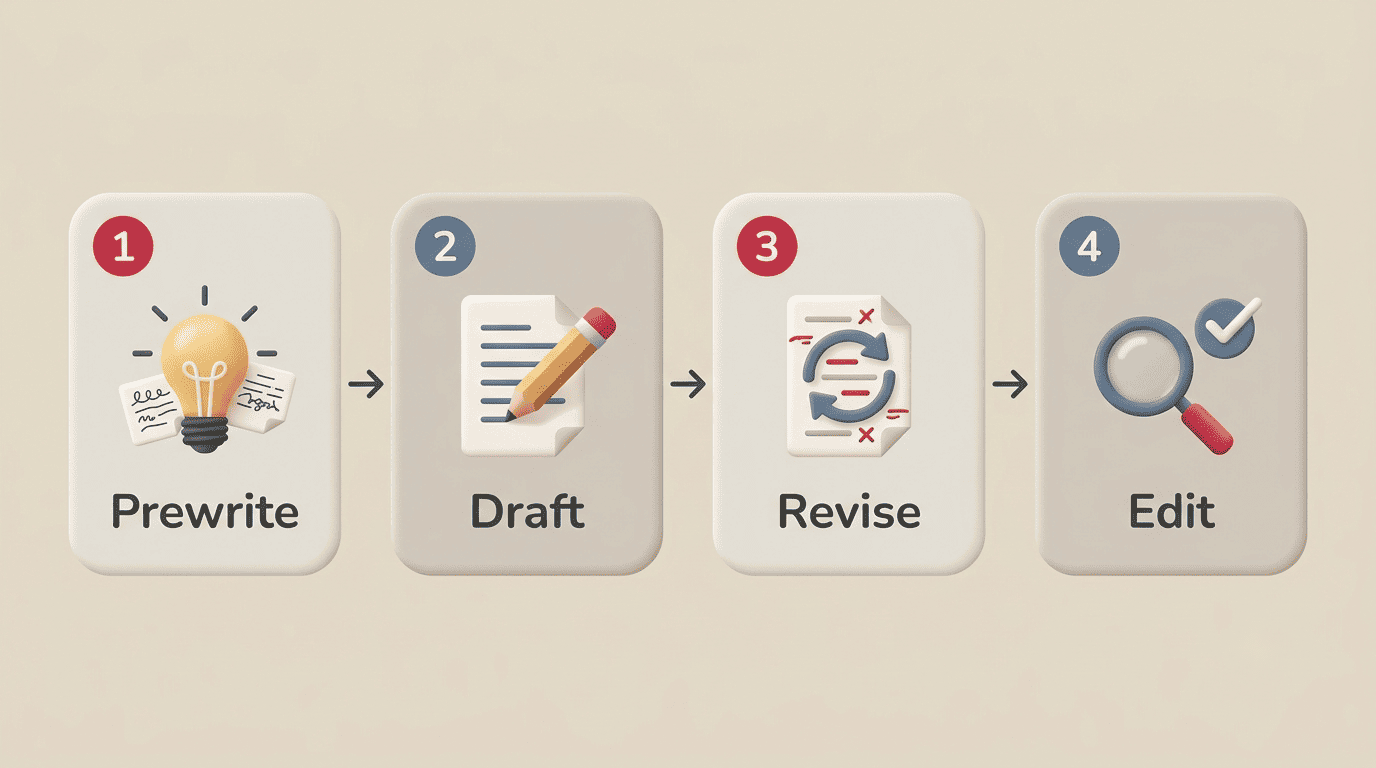
Table: stage-by-stage
| Stage | Your job | How to use the AI homework helper |
|---|---|---|
| Prewriting | Choose a topic, gather raw ideas | Ask for angles, counterarguments, and questions to consider |
| Outlining | Organize ideas into structure | Ask it to sanity-check your outline’s logic and gaps |
| Drafting | Write every sentence yourself | Don’t use it here — this is your work |
| Revising | Re-read for argument and clarity | Ask for feedback on weak spots, then rewrite them yourself |
| Editing | Fix grammar and polish tone | Use it to flag errors, not to rewrite your voice |
Step 1 — Brainstorm Topics and Angles
Turn a blank page into options
Use the AI to widen your options, not to decide for you. A few prompt examples that keep the tool in a brainstorming role:
- “What are 5 debatable angles on _?”
- “What’s a strong counterargument to _?”
- “What would a skeptic ask about my topic?”
- “What’s a narrower version of this topic I could actually cover in 1,200 words?”
Purdue OWL’s own advice on invention is to write down everything you can think of first, then reread and evaluate which ideas are actually worth pursuing — that evaluation step is yours, not the AI’s.
You pick the angle
The helper lists possibilities; you choose based on the assignment prompt and what you can actually defend with evidence. If you can’t explain why you picked an angle, you’re not ready to outline it yet.
Step 2 — Build an Outline and a Strong Thesis
Draft your thesis first, then pressure-test it
Write your own one-sentence claim before you open the AI homework helper. Then ask it to challenge that claim: “Is this arguable? Is it too broad? What evidence would I need to support it?” Take the pushback and revise the thesis yourself — the sentence that ends up in your essay should be one you rewrote, not one the tool handed you.
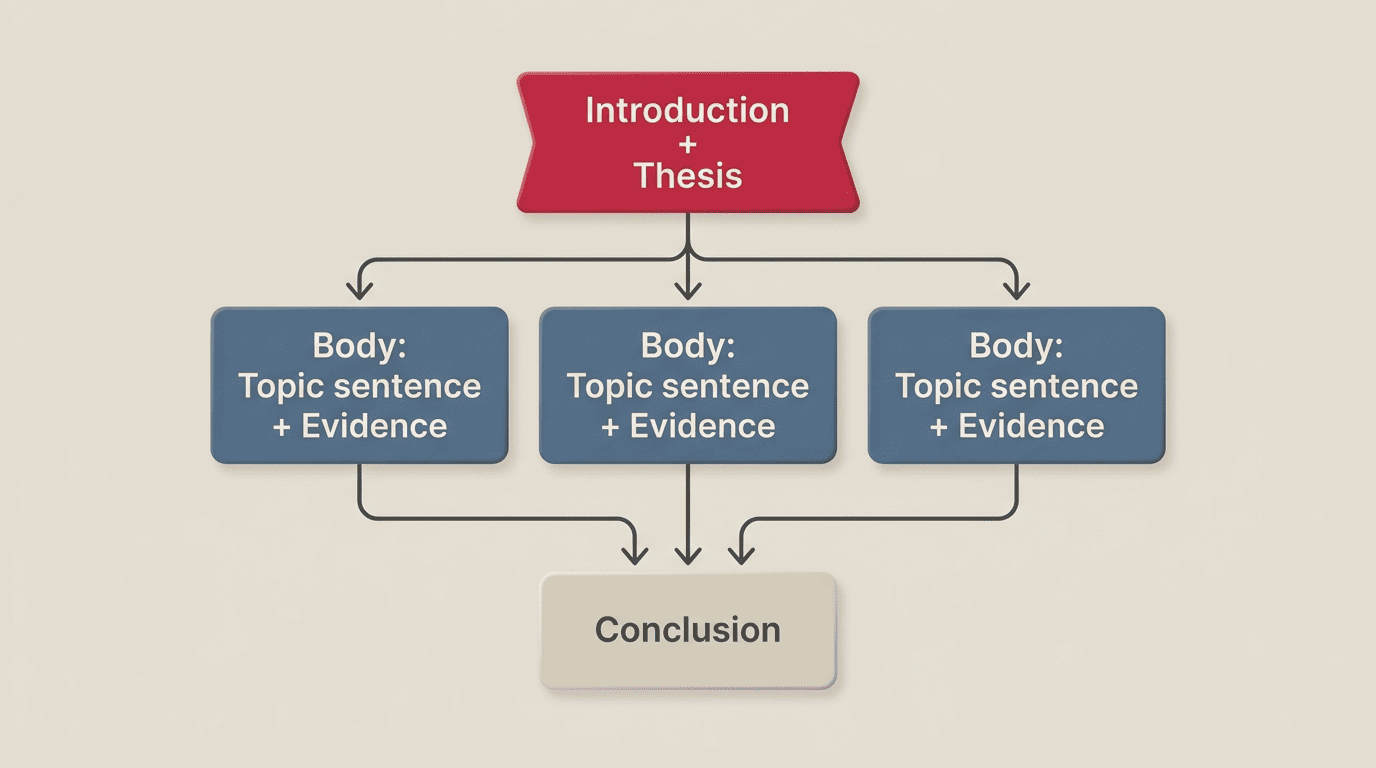
Shape the skeleton
Purdue OWL’s outlining guidance recommends grouping related ideas, ordering them from general to specific, and labeling main points with sub-points underneath. A standard essay skeleton follows the same logic: introduction with thesis, then a series of body paragraphs, then a conclusion that connects back to the thesis.
Each body paragraph needs:
- A topic sentence tied directly to the thesis
- Evidence — a quote, statistic, or example
- Your own analysis explaining why that evidence matters
- A transition into the next paragraph’s idea
Step 3 — Strengthen Structure and Evidence
Tighten paragraph flow
Once you have a full draft, ask the AI writing assistant for feedback on transitions, on whether topic sentences actually match what each paragraph argues, and on whether every paragraph supports the thesis. You make the edits — the tool only points at the weak spots.
Never trust AI citations
AI models can hallucinate citations for sources that don’t exist. They generate plausible-sounding author names, journal titles, and page numbers that were never published anywhere. According to Wikipedia’s entry on AI hallucination, large language models can produce confident, fluent outputs that are factually false — including invented references formatted to look credible.
The rule: every quote, statistic, and citation gets verified before it goes in your essay. To check:
- Search your library database for the exact source, not just a paraphrase
- Confirm the author, publication, and date match what the AI claimed
- If you can’t find the source independently, cut it — don’t cite it on faith
Step 4 — Get Feedback and Revise Your Own Draft
Ask for a reverse outline
Paste your own draft — not a prompt, your actual paragraphs — and ask the AI to summarize what each paragraph is arguing. Mismatches between what you meant and what it read back reveal weak structure. You rewrite the paragraph, not the tool.
Feedback prompts that build skill
Prompts that push you toward stronger revision without handing you finished text:
- “Where is my argument weakest?”
- “Which sentences are unclear or hard to follow?”
- “Am I telling the reader my point instead of showing evidence for it?”
- “Does my conclusion actually follow from my body paragraphs?”
Take the answers and revise in your own words. Purdue OWL describes revision as re-seeing your topic, your ideas, and your audience — a step no tool can do for you, because it requires judgment about what you meant to say.

The Integrity Line: Coaching vs. Cheating
Where the line sits
| Green light | Red light |
|---|---|
| Brainstorming ideas and angles | Generating paragraphs you submit as-is |
| Outline and structure feedback | Fabricated or unverified citations |
| Feedback on your own writing | Hiding AI use when disclosure is required |
| Grammar and clarity checks | Letting AI write your thesis or conclusion |
Submitting AI-written text as your own creation is academic misconduct at most schools, and many now require students to disclose any AI use in a course syllabus or assignment sheet.
Disclose when asked
Check your syllabus before you open any AI essay helper. Policies vary widely by instructor and by school — some allow brainstorming help freely, others ban AI entirely, and some require a disclosure statement listing exactly how you used it. When in doubt, ask the instructor directly. Transparency protects you far better than hoping nobody notices.
Plagiarism and AI-Detection Risk
Why “will they catch me” is the wrong question
Even setting ethics aside, AI detectors are inconsistent. They miss real AI-generated text and, just as often, flag genuine human writing as machine-generated — a problem that disproportionately affects non-native English speakers, whose more formulaic sentence patterns can trigger false positives. The safe path is also the honest one: write the essay yourself and use the AI homework helper only for coaching.
Protect your own work
- Keep drafts and version history so you can show your process if questioned
- Run your final essay through your school’s plagiarism checker before submitting
- Cite every source properly, in the format your class requires
- Save your brainstorming and outline notes as evidence of your own thinking